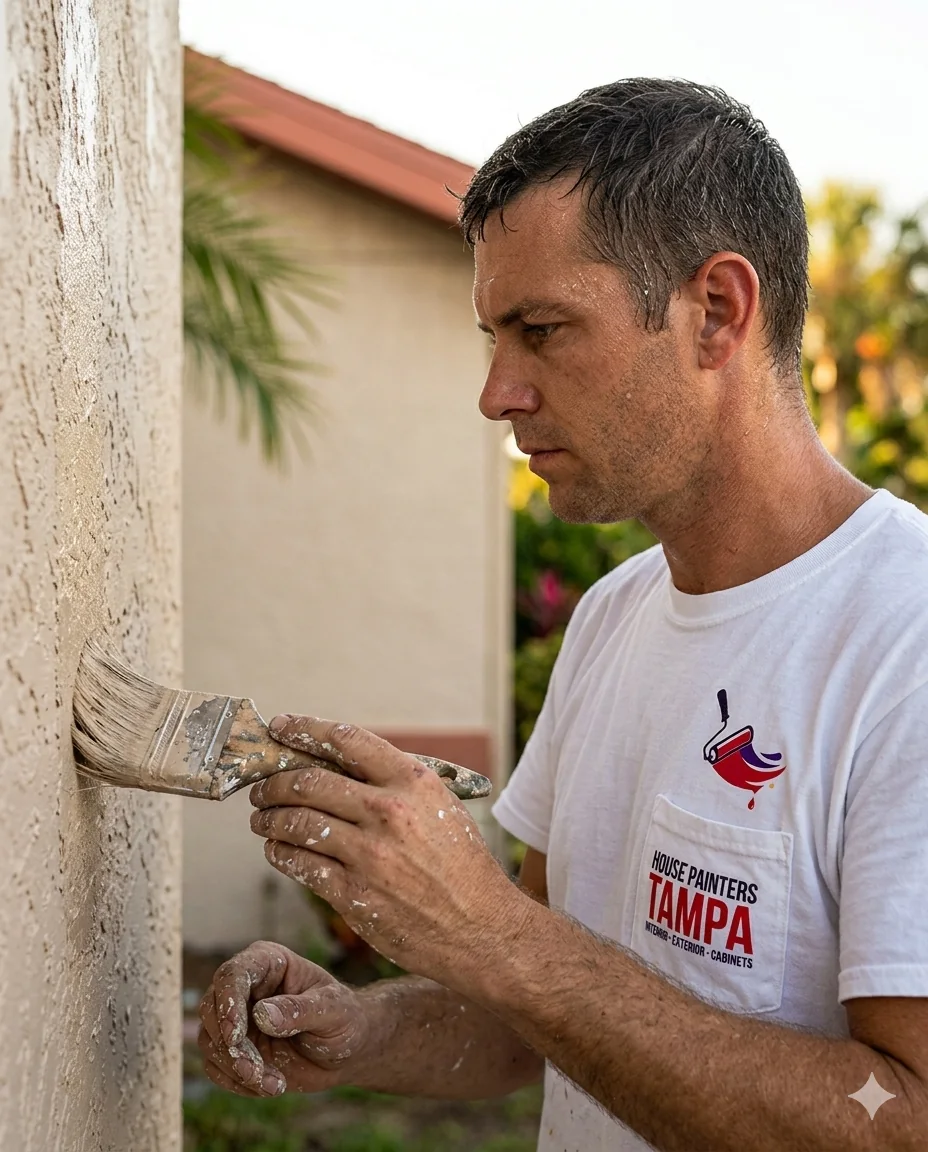
Florida's sun, humidity, and storms are uniquely hard on exterior paint. Here's what actually holds up on a Tampa home — and what to avoid.
If you've watched a freshly painted Florida home start fading, chalking, or peeling within a couple of years, you've seen what our climate does to the wrong paint. Tampa exteriors face a punishing combination of intense UV, high humidity, wind-driven rain, and salt air near the coast. Choosing the right exterior coating — and prepping correctly — is the difference between a finish that lasts a decade and one that fails fast.
Why Florida is so hard on exterior paint
Three forces gang up on Tampa exteriors. First, UV radiation: our near-constant sun breaks down paint binders and fades color, especially on south- and west-facing walls. Second, moisture: high humidity, afternoon downpours, and morning dew feed mildew and push moisture into and out of surfaces. Third, heat: thermal expansion and contraction stress the paint film day after day. Cheap paint simply isn't built to survive all three at once.
The best types of exterior paint for Tampa homes
100% acrylic latex
For most Tampa homes with wood, fiber cement, or previously painted surfaces, a high-quality 100% acrylic latex is the workhorse choice. Premium acrylics from Sherwin-Williams and Benjamin Moore flex with temperature swings, resist UV fading, and shed moisture while still breathing. They hold color and gloss far longer than economy paints.
Elastomeric coatings for stucco
Stucco is everywhere in Tampa, and it's prone to hairline cracking. Elastomeric coatings are thick, flexible, waterproof films that bridge small cracks and stretch with the surface. On the right stucco home — properly prepped and patched first — elastomeric can provide outstanding, long-lasting protection against wind-driven rain. It's not right for every situation, which is why a professional assessment matters.
The right primer
Primer isn't optional on Florida exteriors. Bare wood, patched stucco, stains, and chalky old paint all need the right primer so the topcoat bonds and lasts. Spot-priming repairs and bare areas — or full priming on problem surfaces — is part of any quality exterior job.
Paint quality matters more than color
Homeowners agonize over color (understandably), but the single biggest factor in how long your exterior lasts is paint quality plus prep. A premium paint contains more and better resins, pigments, and additives — including mildewcides that matter enormously in humid Tampa. Stepping down to a builder-grade or bargain paint to save a little up front almost always costs more over the life of the job.
Prep is half the battle
Even the best paint fails over bad prep. A lasting Tampa exterior starts with a thorough pressure wash to remove dirt, chalk, and mildew, followed by scraping loose paint, patching cracks, repairing rotted fascia, caulking gaps, and priming. Paint cannot bond to a dirty or damaged surface, no matter how premium it is. When a quote seems too good to be true, prep is usually what's missing.
Watch the weather window
Florida's rainy season demands smart scheduling. Fresh paint needs dry time to cure, so a good crew watches the forecast and plans exterior work around afternoon storms rather than rushing a coat ahead of the rain. Painting in the right conditions is part of making the finish last.
How often will you need to repaint?
With premium coatings and proper prep, many Tampa exteriors look great for 7 to 10 years, though high-sun walls may show wear sooner. With cheap paint and skipped prep, you might be repainting in 2 to 3 years. The math strongly favors doing it right the first time.
Get the right paint on your Tampa home
Choosing the best exterior paint isn't just about grabbing the priciest can — it's about matching the right product to your home's surfaces and condition, then prepping properly and applying it in the right conditions. That's exactly what we do on every exterior project. If you'd like an honest assessment of your home and a written estimate, reach out anytime.
Color choices that hold up in Florida sun
Color isn't only an aesthetic decision on a Florida exterior — it affects how the paint ages. Deep, saturated colors and dark tones absorb more heat and tend to fade faster under our intense UV, because the pigments take more of a beating. Lighter and mid-tone colors generally hold their look longer and keep the home cooler. If you love a bold color, it can absolutely be done; just know that high-quality, fade-resistant formulations matter even more when you go dark.
Many Tampa neighborhoods, especially planned communities, also have HOA-approved palettes. Part of a smart exterior project is choosing a color that both suits your home and satisfies any community guidelines, so you're not repainting after a violation notice. A good painter helps you navigate that.
Sheen matters too
Beyond color and quality, the sheen (gloss level) of your exterior paint plays a role. Flat and matte finishes hide surface imperfections on stucco and older walls but can be harder to clean. Satin and low-luster finishes offer a nice balance of appearance and washability and are a popular choice for Florida body coats. Higher-gloss finishes are typically reserved for trim, doors, and accents where you want durability and a crisp look. Matching the right sheen to each surface is part of a professional result.
Spraying vs. brushing and rolling
How the paint goes on matters as much as what goes on. Spraying lays down an even coat quickly and is excellent for stucco texture and large surfaces, but it needs careful masking and back-rolling to work the paint into the surface for adhesion. Brushing and rolling give control on trim and detail work. Professionals combine techniques to get both even coverage and proper adhesion — another reason application skill, not just the paint can, determines how long your exterior lasts.
How many coats does a Tampa exterior need?
For most exterior repaints, two finish coats over proper primer is the standard that delivers full, even color and the film thickness needed to protect against Florida weather. A single thin coat — common on bargain jobs — may look acceptable on day one but wears through far sooner, especially on sun-blasted walls. Dramatic color changes and porous or repaired surfaces can call for additional priming or coats. When you compare quotes, ask how many coats are included; it's one of the quiet places corners get cut.